
Google Ads for Therapists: How to Choose What Keywords to Target
At Watts Ahead Marketing, I specialize in running Google Ads for therapists, and especially solo practices spending as little as $20/day on ads. At that budget, every cent counts, so in this post I wanted to talk about the biggest thing that makes, or breaks, a successful Google Ads campaign.
Your targeting.
Skip "Therapy for Anxiety": Why the Obvious is Problematic
It's natural to want to reach people suffering from common problems. "Therapy for anxiety," "depression counseling," or "relationship therapy" are common things people search for, and they might be your ideal clients, so they’re a no-brainer for Google Ads, right?
Not so.
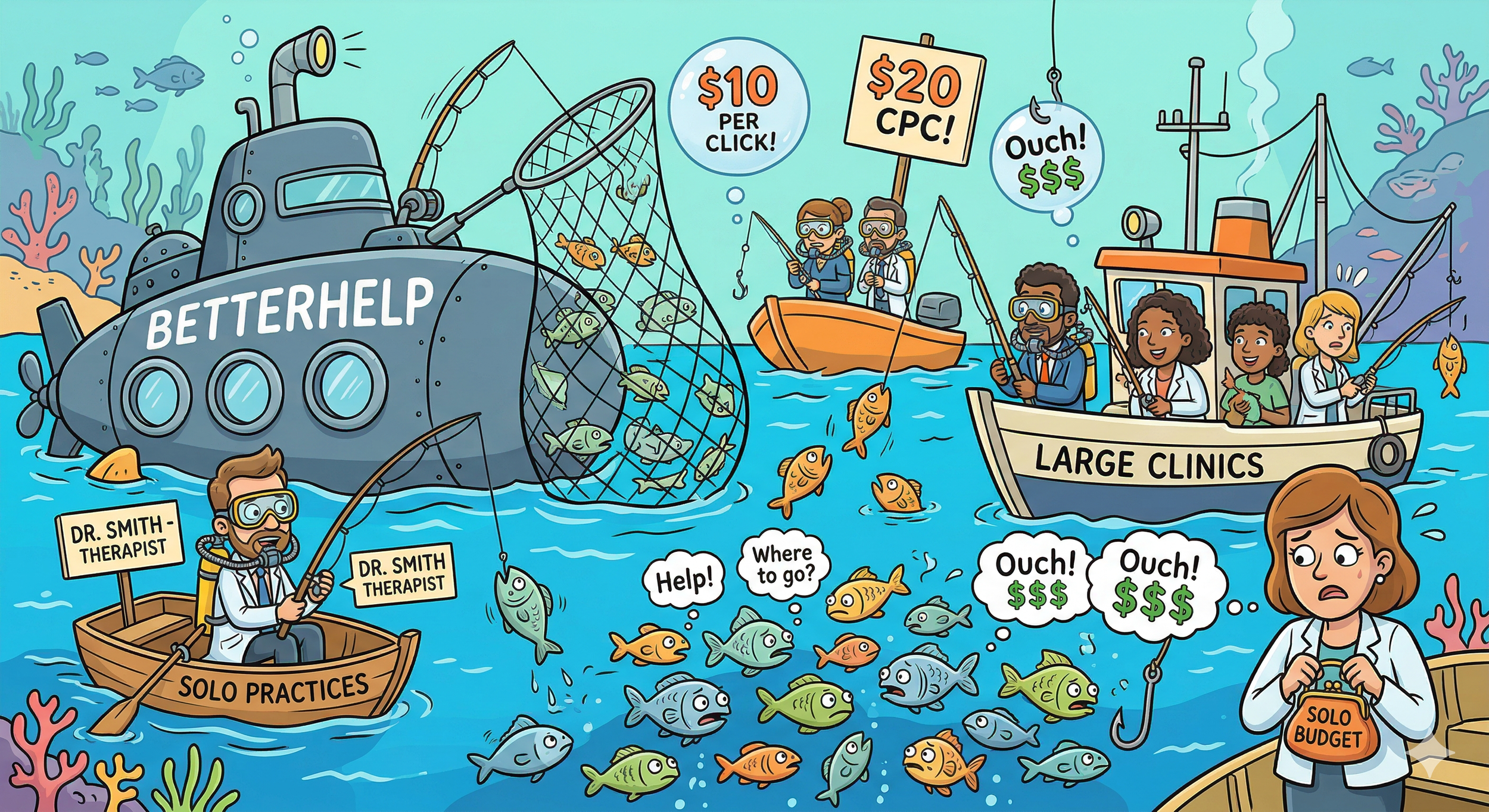
Imagine an ocean where every therapist, large clinic, and—gulp—BetterHelp are all vying for the same anxious fish. This intense competition drives up the Cost-Per-Click (CPC) exponentially. You might be paying $10, $20, or even more for a single click. While a high CPC isn't inherently bad if those clicks convert into clients, the reality for many therapists, particularly solo practices, is that you absolutely can’t afford to pay $10 or more per click.
Why? Because the searcher typing "therapy for anxiety" might be looking for anything from medication management to a support group, a quick coping tip, or a specific type of therapy. Your ad, even if well-written, is just one among dozens, and it might not resonate deeply enough with a broad searcher to prompt them to click and then convert. You're throwing a wide net into a highly fished area, and the cost of the net might far outweigh the catch, and all of the big fishing corporations with their fancy and expensive nets have already got all the juiciest fish.
I’m going to leave the fishing metaphors here. I don’t even know why I started with them, I don’t know anything about fishing.
Finding Your Niche
Instead of good old regular anxiety, Google Ads perform much, much better if you find a nice, quiet, cosy little niche. Instead of competing on the busiest freeways, you want to find the quieter, more specific paths where your ideal clients are actively searching for exactly what you offer. Having a niche is a strategic advantage that allows you to:
Reduce CPC: Less competition means lower bids, stretching your precious ad budget further.
Increase Click-Through Rate (CTR): When your ad directly speaks to a specific need, searchers are much more likely to click.
Improve Conversion Rates: Those who click are often pre-qualified and more likely to book an appointment because they found exactly what they were looking for.
Establish Authority: Becoming known for a specific area of expertise positions you as a specialist, not just another generalist.
So, how do you find your niche?
1. Look Beyond the Obvious: Specialized Modalities
Think about the unique therapeutic approaches you offer. Do you specialize in Eye Movement Desensitization and Reprocessing (EMDR)? This is a fantastic example of a powerful niche. People searching for "EMDR therapy near me" or "trauma EMDR specialist" are often further along in their decision-making process. They know what they're looking for, and if you offer it, your ad will stand out. The competition for "EMDR therapy" is significantly lower than "anxiety therapy," leading to a much more efficient use of your ad spend.
Consider other specialized modalities:
Cognitive Behavioral Therapy (CBT) for Insomnia: Instead of just "insomnia therapy," specifying CBT narrows the field (also CBT-I).
Dialectical Behavior Therapy (DBT) for Borderline Personality Disorder: A highly specific and effective approach.
EMDR Therapy: lots of therapists target people looking for “trauma therapy”, but there are lots of people intentionally looking for an EMDR approach and it’s a much less competitive way to target.
2. Address Specific Life Stages or Demographics
Sometimes, your niche isn't just about the "what" but the "who." Perhaps you work exclusively with:
LGBTQ+ couples: Demographics with unique challenges would love to work with someone who specifically specializes and resonates with their background.
Couples Navigating Infertility: A very specific and emotionally charged life event that requires specialized support.
Therapy for First Responders: Addressing the unique psychological impact of demanding professions.
Therapy for Expats: Helping individuals adjust to life in a new country.
3. Focus on Uncommon or Underserved Issues
Are there particular issues you're passionate about or uniquely skilled in addressing that aren't saturated with therapists?
Spiritual Counseling for Grief: Combining psychological support with spiritual exploration for those experiencing loss.
Therapy for Chronic Pain Management: A niche often overlooked by general therapists.
Therapy for Social Anxiety: Anxiety is super common, but what about specific kinds of anxiety like social anxiety, OCD, or something else? There’s a much better chance that it’s less competitive.
The Critical Google Ads Balance: Niche vs. Search Volume
While niching down is effective, don’t go too far. Targeting “spiritual counseling for expats with social anxiety” would have nobody searching for it, and since Google Ads only shows to people searching your keyword, you’ll end up not spending anything.
How to assess search volume:
Google Keyword Planner: This free tool (you need a Google Ads account) allows you to research keywords, see their average monthly searches, and gauge competition levels. But honestly, for therapists it’s quite useless since any health-related keywords won’t return results. (Things like couples counseling or therapy for expats should be okay, at least at time of writing.)
Ubersuggest, Ahrefs, SEMrush: These paid tools offer more in-depth keyword research features, including competitive analysis and related keyword suggestions. But honestly, if you’re only spending $20/day on ads, it’s not worth the additional cost.
Start Broad, Then Refine: Begin with a slightly broader term in your research (e.g., "trauma therapy") and then look at the "related keywords" or "people also ask" sections for more specific, niche ideas (e.g., "EMDR for complex trauma," "IFS therapy for PTSD").
If you identify a highly specific niche with virtually no search volume, it might be too narrow for a Google Ads strategy. In those cases, Google Ads won’t work and using Meta Ads, reaching out on social media, writing blog posts, etc. might be more effective. [Read my guide on writing blog posts for therapists here.]
The goal of Google Ads is to find that sweet spot where competition is lower, but search interest is still robust enough to fill your practice.
How to Structure Your Google Ads Campaigns for Therapists
Once you've identified your niche, your Google Ads setup needs to reflect this precision:
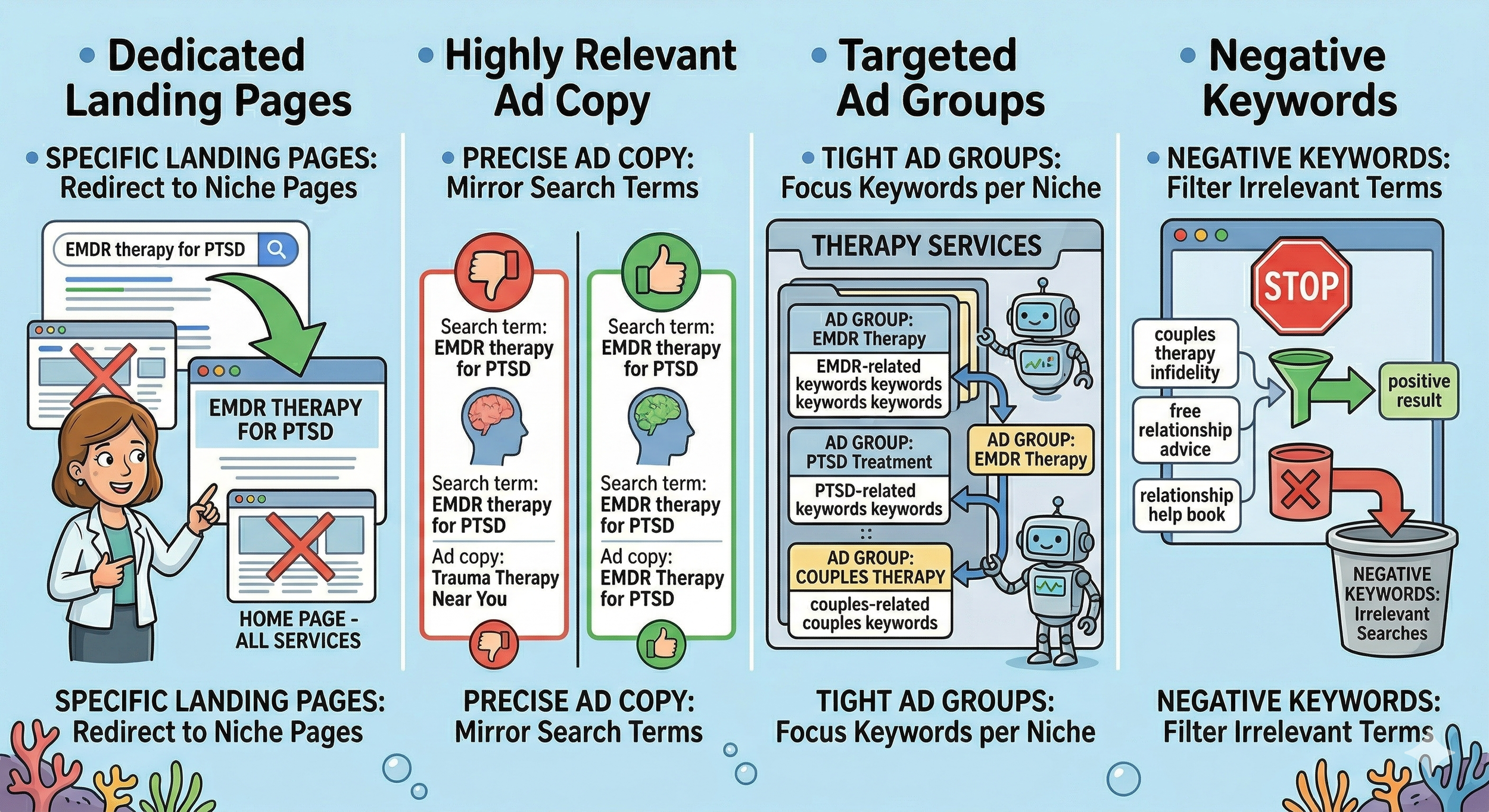
Dedicated Landing Pages: Don't send niche-specific traffic to your general homepage. Sending someone searching for “EMDR therapy” to a homepage that talks about all of your services is the fastest way to blow through your budget with no rewards.
Highly Relevant Ad Copy: Your ad headline and description must mirror the keywords your niche clients are searching for. If someone searches "EMDR therapy for PTSD," your ad should ideally include "EMDR" and "PTSD”, not just “Trauma Therapy Near You”.
Targeted Ad Groups: Structure your Google Ads account with tight ad groups, each focusing on a very specific set of keywords related to one niche.
Negative Keywords: Continuously add negative keywords to prevent your ads from showing for irrelevant searches. For example, if you offer "couples therapy for infidelity," you might want to add "free," "book," or "relationship advice" as negatives. Review your search terms report to stay on top of this as much as possible.
Conclusion: Work Smarter, Not Harder
With Google Ads for therapists, it might seem like common sense that you want to target “therapy for anxiety” and throw all your money at that. But it’s often a recipe for frustration and wasted money. By getting smart and strategically identifying and targeting a specific niche – whether it's a specialized modality like EMDR, a particular demographic, or an underserved issue – you can significantly improve your campaign's performance. You'll attract clients who are actively seeking your unique expertise, reduce your ad spend, and ultimately build a thriving, sustainable practice. Stop competing in the open ocean; find your quiet, abundant stream.
Sorry, couldn’t help but end on a water metaphor again.
If you’re new to Google Ads, read my simple guide to Google Ads for therapists here.
And if the thought of setting up ads yourself makes you want to run away screaming, I offer affordable Google Ads services specifically designed for therapists. Reach out for a free call here.